
If you run a SaaS product, service website, e-commerce shop, or any online business, legal policies are a must requirement you want your visitors to read through and agree with.
Once you start looking into user consent, you will come to two distinct solutions, browsewrap and clickwrap agreements. But how do they differ and which one is better?
What Is a Browsewrap Agreement?
A browsewrap agreement is an online agreement method located on the website, usually in the footer or a hyperlink that argues that the user accepts the businesses terms by simply using their website/service.
Browsewrap agreements are most used for website Terms of Service or Terms and Conditions paired with wording telling the user that by browsing, accessing, or using the website, they agree to those specific terms.
Browsewrap VS. Clickwrap - Key Differences
While there are many ways for you to capture user agreements, besides browsewrap, the most common and industry used acceptance types is clickwrap agreements.
To most, these two types sound the same, however, there are many differences that make them useful in different situations.
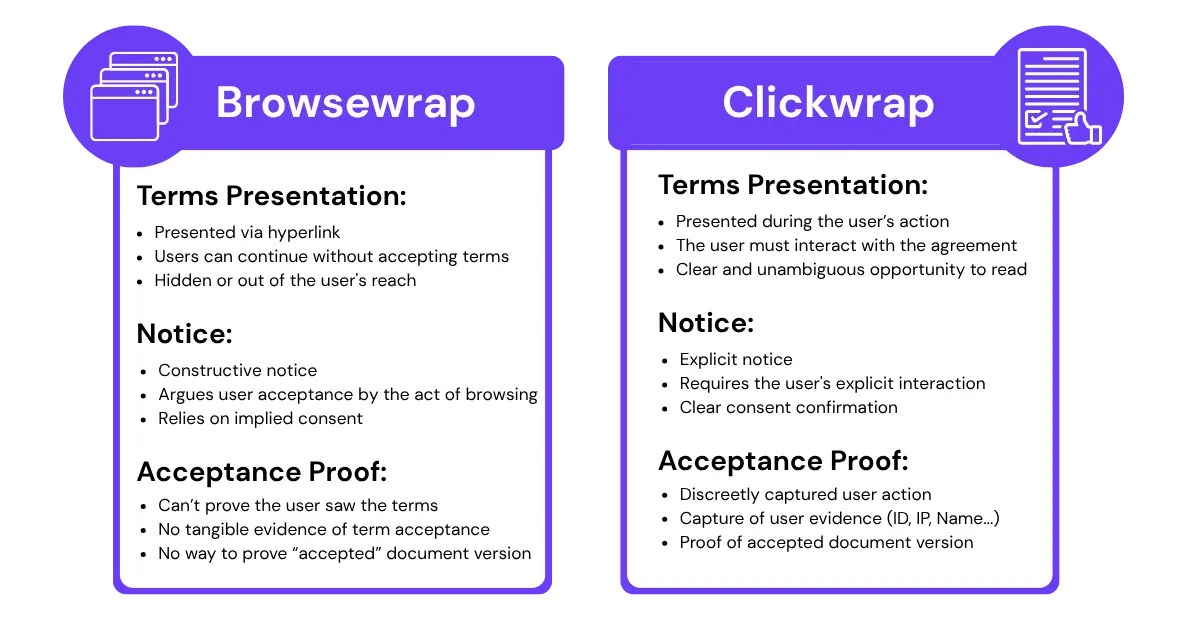
How Terms Are Presented
In a browsewrap flow, the terms are usually presented through a hyperlink on the webpage, however, they aren't necessarily presented at the moment when the user is to take an action allowing the user to continue using the website without opening the terms at all.
On the other hand, a clickwrap flow presents the user with the terms directly when they would take action, giving you an argument that the user had a fair and unambiguous opportunity to read your terms before proceeding with browsing.
In short, browsewraps usually are not clearly presented while clickwraps are always clearly presented to the user.
This one reason makes clickwraps much more likely to be upheld in litigation as the user was clearly shown the terms without the need to find them on their own.
How Notice Is Given
Browsewrap is built upon constructive notice, or in other words, it argues that through the act of browsing the website, the user already agrees to the terms as there was always a link somewhere on the page.
By contrast, clickwrap agreements are built around explicit notice. The user must explicitly interact with a checkbox, button or "I Agree" in the terms window, which gives a much clearer consent confirmation.
This is the most important difference between clickwraps and browsewraps, one is explicit, the other one is implied, and when it comes to litigation, implied consent found in clickwrap holds much more weight.
How Acceptance Is Proven
With browsewrap, acceptance of terms can't clearly be proven because it isn't tied to an explicit action or event.
"The user used the website; therefore, they accepted the terms." is the usual answer to proving that a user accepted a browsewrap agreement, however, this reasoning isn't going to hold up in litigation.
Even if the terms were presented clearly, you would still struggle to show that the user actually saw them, understood them, and agreed to them without clear action and record of that action.
Clickwrap acceptance is much easier to prove because there is a discrete action tied to the agreement (checkbox, button...). This one click creates a record of the action with a clear timestamp, user information (IP, Name, Email...), or screenshot that is all evidence of the user's act of acceptance.
Are Browsewrap Agreements Legally Enforceable?
Short answer, sometimes yes, reliably, no.
The issue isn't that browsewraps aren't legally enforceable. The real issue is how the agreement is presented to the user and how they are accepted. These two weak elements are quite easy to challenge in court.
Because most browsewrap agreements are hidden and require user to manually find them, in litigation, a court may find browsewrap agreements hiding the website terms from its users, such was the case of Specht v. Netscape.
While Netscape did have license agreements on their website, the court ruled that many users weren't even aware of them as they weren't explicitly shown to the users that downloaded their software.
On the other hand, browsewrap agreements are hard to enforce due to their nature of being implied instead of willingly accepted through the user's action.
In the Nguyen v. Barnes & Noble case, the Ninth Circuit refused to enforce the websites' terms. While the terms were shown through a hyperlink that was clearly visible, the users weren't prompted to take any affirmative action to demonstrate that they accept the terms.
Which Agreement Type Should You Choose for Your Business?
The answer depends on your business's terms and how much they matter in the big picture. If they are important to you, choose clickwrap.
While browsewrap agreements have their place for general website terms on low-risk pages like informational content where you're not relying on active user agreements.
This makes browsewraps great for:
- Terms and conditions
- Shipping policy
- Return and refund policy
As in most cases, these documents aren't legally required.
However, if you need users to agree to account rules, renewals, arbitration, IP rights... Clickwrap agreements are the safest and most reliable choice as they create a clear notice that the user agreed to your terms making them better evidence.
This is especially true for most SaaS, e-commerce businesses, and digital platforms as they need clear user consent to register on their website, pass through checkout, download software, or receive a service.
The clear consensus is that you can use browsewrap agreements for general site-level terms if you're comfortable with uncertainty. However, if you want your business to operate stress-free, clickwrap agreements are the go-to standard.
Conclusion
Browsewrap and clickwrap agreements are often understood as two versions of the same thing, but they solve different problems.
Browsewrap is lightweight on the business and the user, however, it doesn't carry the same legal weight as clickwrap that asks more from the user upfront but gives you better records of user consent making them more enforceable.
This is why, for most businesses, the debate of browsewrap vs clickwrap has a clear answer. If your agreements are important, it's important to capture them clearly, which is solved with clickwraps.