
Clickwrap agreements are a common feature of online contracting, but their legal status is often described too broadly. The relevant question is not simply whether clickwrap can be enforceable, but how it should be understood in relation to other online assent formats, electronic signatures, and handwritten contracts, and what conditions make a particular clickwrap flow reliable in practice.
The legal position of clickwrap depends on more than the presence of an "I agree" button. It depends on how the terms are presented, how assent is obtained, what record of acceptance is preserved, and whether clickwrap is the appropriate level of formality for the transaction involved.
What Is a Clickwrap Agreement?
A clickwrap agreement is a method of forming an electronic contract in which a user accepts legal terms by taking a clear affirmative action, such as clicking an "I agree" button, checking an unchecked box, or selecting "Accept" before proceeding. In legal and practical terms, that acceptance functions as a simple electronic signature or electronic act of assent tied to the relevant agreement.
In practice, clickwrap is commonly used to bind users to standard online terms, including terms of service, software license agreements, subscription terms, sales terms, and other contractual terms presented in digital flows.
Its defining feature is not simply that the terms are available somewhere on a website or application. Rather, the user is presented with the terms, or given clear notice of them, and is then required to take a specific action that objectively signals acceptance. The agreement is formed through that combination of notice and affirmative assent.

Are Clickwrap Agreements Legally Binding?
Clickwrap agreements are enforceable when they are used to form standard online contracts, and the user is given clear notice of the terms and takes an unambiguous action to accept them.
Legally, clickwrap is not a separate class of contract. Its validity depends on ordinary contract principles such as notice, assent, and proof of what was accepted. In jurisdictions that recognize electronic contracting, the fact that acceptance occurred digitally does not by itself make the agreement invalid.
Under the U.S. ESIGN Act, a signature, contract, or record may not be denied legal effect, validity, or enforceability solely because it is in electronic form, and a contract may not be denied legal effect solely because an electronic signature or electronic record was used in its formation.
Clickwrap's Legal Status
Clickwrap is best understood as a legally recognized method of capturing assent to contractual terms in an electronic environment. Its legal effect does not come from the label "clickwrap" itself, but from the fact that the flow satisfies the same basic requirements that govern contract formation more generally:
- The user is given notice of the terms.
- The user takes an affirmative step to accept them.
- The business can later produce evidence linking that act of acceptance to the relevant agreement.
Courts assessing online assent generally focus on those issues of notice and manifestation of assent. In Meyer v. Uber, for example, the Second Circuit upheld Uber's sign-up flow because the interface provided reasonably conspicuous notice of the terms, and the user's assent was unambiguous.
That said, the legal position should not be overstated. It is more accurate to say that clickwrap is often enforceable than to say that it is always legally identical to a paper contract signed by hand.
Electronic contracting laws remove discrimination against electronic form, but they do not eliminate other legal questions relating to notice, proof, transaction type, or compliance with formal requirements that may still apply under other laws.
How Do Clickwrap Agreements Differ from Other Online Agreements
Clickwrap is one of several methods used to capture assent in an online environment. The main legal difference between these formats is how clearly the user is notified of the terms and how direct assent is obtained.
- Browsewrap agreements make terms available through a hyperlink, usually in a footer or elsewhere on the page, and rely on continued use of the site as acceptance. Because browsewrap does not usually require a separate act of assent, it is generally the weakest online assent format from an enforceability perspective.
- Sign-in wrap agreements inform users that by signing in, registering, or continuing with a transaction, they are agreeing to the platform's terms. They are generally stronger than browsewrap because assent is tied to a user action, but they may still be less reliable than clickwrap if the notice is not sufficiently clear or is not presented close enough to the relevant button or action.
- Scrollwrap agreements require the user to scroll through the terms before clicking to accept them. In practice, scrollwrap is usually treated as a variation of clickwrap rather than a separate legal category, but it is sometimes distinguished because the interface requires an additional step before acceptance.
The distinguishing feature of clickwrap is that assent is tied to a separate and deliberate act directed at the terms themselves. For that reason, clickwrap generally provides clearer evidence of agreement than passive or implied online assent formats.
How Clickwrap Differs from Written Documents and E-Signatures
Clickwrap is most accurately understood as a lower-formality method of evidencing contractual assent in an electronic environment. In most cases, the user's act of clicking an acceptance button or checking a consent box will function as a form of simple electronic signature or electronic act of assent attached to the relevant agreement.
As a matter of legal effect, clickwrap can be sufficient to form an enforceable contract without being equivalent, in all respects, to either a handwritten signature or a more formal electronic signature process. The fact that assent is captured electronically does not, by itself, deprive the agreement of legal force in jurisdictions that recognize electronic contracting. However, that principle should not be overstated. The legal recognition of electronic acceptance does not mean that all methods of signature or assent carry the same degree of evidentiary weight, identity assurance, or procedural formality.
This distinction is particularly relevant in legal systems that differentiate between levels of electronic signature. In such systems, clickwrap will ordinarily fall at the lower-assurance end of the spectrum. It may be legally effective for standard online agreements, but it will not necessarily provide the same level of authentication, integrity protection, or resistance to challenge as a more formal signature method.
When comparing clickwraps with handwritten contracts, a clickwrap agreement may be fully enforceable while still not being legally identical, for every purpose, to a paper contract executed by hand. In some jurisdictions, electronic contracting rules prevent an agreement from being denied legal effect solely because it was concluded electronically.
In others, the law recognizes electronic signatures generally while reserving full equivalence to handwritten signatures for higher-trust signature types. Under the EU's eIDAS framework, for example, a simple electronic signature may be legally valid, but only a qualified electronic signature is expressly given the legal effect of a handwritten signature. For that reason, a typical clickwrap acceptance does not carry the same legal status as a handwritten signature in every context.
When Clickwrap Is Usually Sufficient and When It Is Not
Clickwrap is generally well suited to standard-form digital agreements that are accepted as part of a defined online flow, such as terms of service, software and SaaS terms, online sales terms, subscription terms, and routine policy acknowledgments. It works best where the terms are standardized, the acceptance step is tied to a specific user action, and the business needs a clear record of assent without requiring a separate signature process.
Its limits become more apparent where the transaction requires greater formality, stronger identity assurance, or a signature method that law or market practice treats as higher trust. That may be the case for highly negotiated agreements, documents subject to specific execution requirements, or transactions where stronger proof is needed of who accepted the agreement and what exact document was accepted.
In those situations, the issue is not necessarily that clickwrap is invalid, but that it may provide a lower level of evidentiary assurance than the transaction requires. A more formal electronic signature process may therefore be more appropriate, particularly where the agreement carries greater legal, operational, or commercial significance.
What Evidence Is Needed to Make a Clickwrap Agreement Legally Enforceable?
If a clickwrap agreement is challenged, the issue usually isn't whether the user saw a checkbox; it's whether you can reconstruct the acceptance event that is credible.
This means that a simple screenshot or database entry won't hold up; you must be able to show exactly what the user saw, what and when they took the action, and the evidence of their acceptance.
Clear and Visible Terms
You should be able to show that the user was presented with the agreement clearly before accepting it.
If the agreement was hidden behind a vague link or separated from the acceptance flow, the evidence might be too weak to hold up in litigation.
A strong record ties the user's acceptance of action to the exact agreement that was shown at the time.
Explicit User Consent
For clickwrap to be enforceable, acceptance needs to come from a user's clear affirmative action. The user should click "I Agree," tap an acceptance button, or take some other unambiguous step.
Just as important, that action shouldn't just be shown to the user on the websites front-end; it should be properly recorded and verified on the backend and turned into a durable record.
Attributing Acceptance to the User
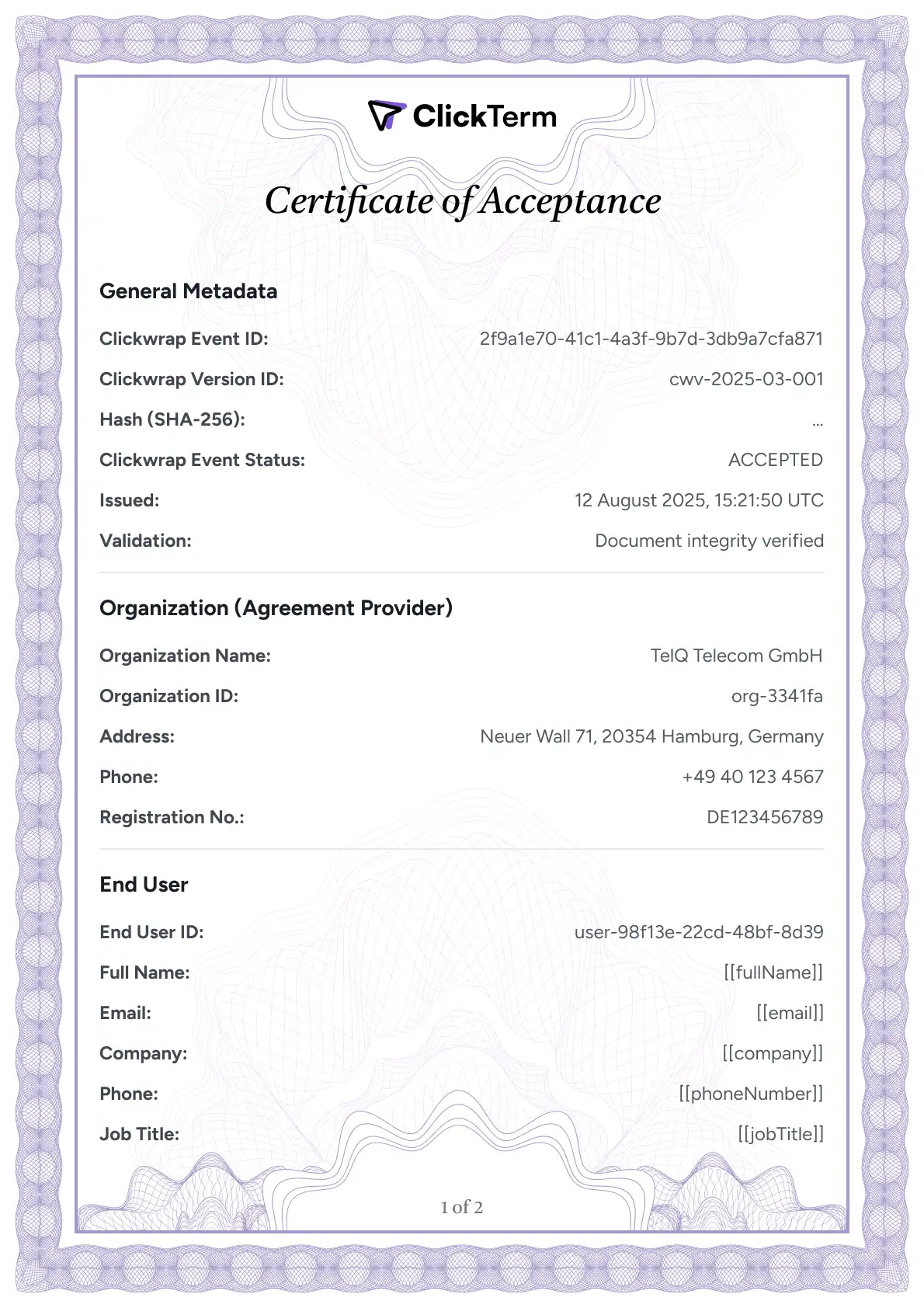
For clickwrap evidence to be persuasive, the acceptance must be attributable to a specific user, account, or transaction. In a dispute, it is not enough to show that an acceptance event occurred somewhere in the system. The record should make it possible to show whose acceptance it was and when it occurred.
The information needed to do that will vary by implementation, but the evidence should be sufficient to connect the assent to an identifiable user interaction rather than an abstract system log. At a minimum, the record should allow the business to relate the acceptance to the relevant user or account and to the time at which the terms were presented and accepted.
Version Control and Audit Trails
Businesses should also maintain records showing which version of the agreement the user accepted. Terms and policies are often updated over time, so it is important to track the specific version that was presented to the user at the moment of acceptance.
Maintaining version control and a detailed audit trail allows businesses to demonstrate that the user agreed to a specific set of terms. These records can serve as critical evidence if the agreement is later examined in a legal dispute.
How to Create a Clickwrap Agreement (Step-by-Step)
Clickwrap agreements aren't just about drafting the terms and conditions and posting them on your website. You need to create a whole flow that helps users understand the terms and captures their acceptance.
In practice, that means treating the legal text, the acceptance interface, the verification step, and the recordkeeping process as one system.
Define the Terms Being Accepted
In a clickwrap flow, the agreement should be defined in a way that makes the user's acceptance specific, traceable, and tied to the step they are taking. The issue is not only what the terms say, but whether the business can later show exactly which terms were presented, what action triggered the acceptance request, and what the user objectively agreed to at that moment.
For that reason, the agreement used in clickwrap should be limited to the terms that actually govern the relevant interaction, whether that is account creation, checkout, subscription signup, or first use of the service. If the flow is asking the user to accept contractual terms, the acceptance should be tied to those terms directly, rather than to a broader or unclear collection of documents that may serve different legal purposes.
The scope of acceptance also needs to be controlled carefully. Contract terms, privacy disclosures, and optional consents should not automatically be bundled into one click merely for convenience. In a clickwrap context, over-bundling can weaken clarity because it becomes less obvious than what the user was required to accept, and what was merely disclosed or optionally agreed to.
Just as importantly, the agreement should be stable before it is presented. The version shown in the clickwrap flow should be identifiable and preserved as the version accepted at that time. If the terms are later revised, the business should still be able to show the exact text that was in effect when the user clicked to accept. In practice, that is part of what makes clickwrap useful: not only that it captures assent, but that it can tie assent to a defined set of terms at a defined point in time.
Design the Clickwrap Interface
A legally effective clickwrap flow does more than displaying a checkbox or acceptance button. It should make clear, at the moment of acceptance, what the user agrees to, where the terms can be reviewed, and what action will constitute acceptance.
The design should therefore do three things at once: give the user clear notice of the terms, connect the notice to the relevant action, and obtain assent through a separate and unambiguous step. In practice, that means the acceptance of language, the link or display of the terms, and the button or checkbox should appear together in a way that leaves little room for confusion about what is being accepted.
To achieve that:
- Place the notice of the terms immediately next to, or directly above, the checkbox or acceptance button, so the connection between the action and the agreement is obvious.
- Make the agreement accessible before acceptance, whether through a clearly labeled hyperlink, embedded text, modal window, or scrollable display.
- Use acceptance language that is specific and legally meaningful, such as "I agree to the Terms of Service," rather than vague wording that does not clearly communicate assent.
- Require a distinct affirmative action, such as checking an unchecked box or clicking on a dedicated acceptance button. Do not rely on passive browsing, inactivity, or pre-checked boxes.
- Ensure that the acceptance control is visually clear and not obscured by surrounding interface elements, competing buttons, or dense layout.
- Present the terms and the acceptance request at the correct point in the user journey, such as account creation, checkout, or subscription signup, so the agreement is tied to the action it governs.
- If multiple documents are involved, make clear which documents are mandatory, which are informational, and which involve optional consent, rather than collapsing them into a single ambiguous acceptance step.
- Ensure the same clarity on mobile as on desktop, especially where space constraints can separate the acceptance language from the button or hide links behind less visible interface elements.
The purpose of the interface is not only to make acceptance easy. It is to make acceptance clear, specific, and later provable. A well-designed clickwrap flow reduces the risk that a user can later argue that the terms were hidden, the notice was unclear, or the acceptance action did not actually communicate agreement.
Implement Consent Tracking
This is where weak clickwrap flows break down because they can't prove that a user "accepted" their terms.
Consent tracking captures every action tied to a specific clickwrap agreement; from the instance it was shown to a user to the final verification of their action.
Your verification system should capture as much detail as possible, like the time of presentation, time of acceptance, user IDs, agreement version, and the action taken.
These data points help show that assent was intentional and tied to a specific agreement at a specific time. Reliable consent tracking is therefore important not only for operational recordkeeping, but also for demonstrating enforceability if the agreement is later challenged.
Store Acceptance Records
Once a user accepts the agreement, the acceptance record should be stored securely so it can be retrieved later if the agreement is disputed. Rather than keeping only a yes-or-no confirmation, you should retain enough information to show what terms were presented, when the user accepted them, and which user, account, or transaction the acceptance relates to.
The record should also be tied to the specific version of the agreement in effect at the time of acceptance. This helps create a reliable audit trail and makes it possible to reconstruct the acceptance event later, which is often critical if enforceability is challenged.
Monitor Changes to Terms and Legal Requirements
A clickwrap flow should not be treated as a one-time implementation. If the underlying terms change, or if legal requirements affecting the agreement change, the business should review whether the flow still presents the correct version of the terms and whether users need to accept an updated agreement.
For that reason, clickwrap processes should be reviewed periodically. Ongoing monitoring helps ensure that the agreement remains aligned with the current product flow, that outdated terms are not still being presented, and that acceptance records remain tied to the correct version of the agreement.
Conclusion
If your business operates on the web, the question isn't "Should we capture user consent?"; it's "Can we do it clearly and in a way that will hold up in litigation?"
That's where clickwrap agreements make your life easier. They help you balance enforcing, scale, and user experience.
A well-designed clickwrap process helps you turn routine online acceptance into a far more reliable system. For businesses, that is not just legal in detail. It's part of building trust, reducing friction, and making sure the agreements that support the business are as scalable as the products and services behind them.