
NDAs are routinely treated as documents that need to be signed. For standardized confidentiality terms shared at scale, that assumption creates friction without adding much protection. A signed NDA sitting in an email thread does little if the information it covers is already being downloaded somewhere else.
Clickwrap NDAs address this by placing the confidentiality obligation directly in the access flow. The recipient is presented with the NDA, accepts it through a clear affirmative action, and only then receives the confidential information. The acceptance mechanism is different from a signed NDA, but the underlying agreement and its obligations are the same.
What Is a Clickwrap NDA?
A clickwrap NDA is a nondisclosure agreement that is accepted through a clear digital assent action instead of a handwritten or electronic signature workflow.
The agreement itself is still an NDA. Like any clickwrap agreement, it can impose the same confidentiality obligations as a signed document, including limits on disclosure, use, copying, distribution, or retention of confidential information. What changes is the acceptance mechanism: the recipient is presented with the NDA in an online flow and must affirmatively agree before proceeding.
Are Clickwrap NDAs Legally Enforceable?
Yes, when the recipient is given clear notice of the agreement and takes an unambiguous action to accept it before receiving confidential information.
A clickwrap NDA is not a separate category of agreement. It is an NDA formed through electronic acceptance, and stands or falls on the same contract principles as any other: notice, assent, and proof of what was accepted.
Under the U.S. ESIGN Act, a contract, signature, or record may not be denied legal effect solely because it is electronic. Courts assessing online acceptance focus on whether the user had reasonable notice of the terms and whether their action communicated assent. In Meyer v. Uber, the Second Circuit upheld an online acceptance flow on exactly those grounds, and the same reasoning applies to clickwrap NDAs.
A clickwrap acceptance functions as a simple electronic signature. That is enough for standard confidentiality agreements but does not carry the same evidentiary weight as a higher-trust signature method. Under the EU's eIDAS framework, clickwrap sits at the lower-assurance end of the spectrum. Sufficient for standard NDA workflows; not equivalent to a qualified electronic signature or a handwritten one.
What Makes a Specific Clickwrap NDA Hold Up
Enforceability in principle is one question. Whether a specific acceptance holds up is another, and it depends on four conditions.
- Timing - Acceptance must happen before the recipient gains access to the confidential information. If the material is reachable before the NDA is accepted, the recipient was not bound when they received it. The NDA should sit directly in front of the access point, not alongside it.
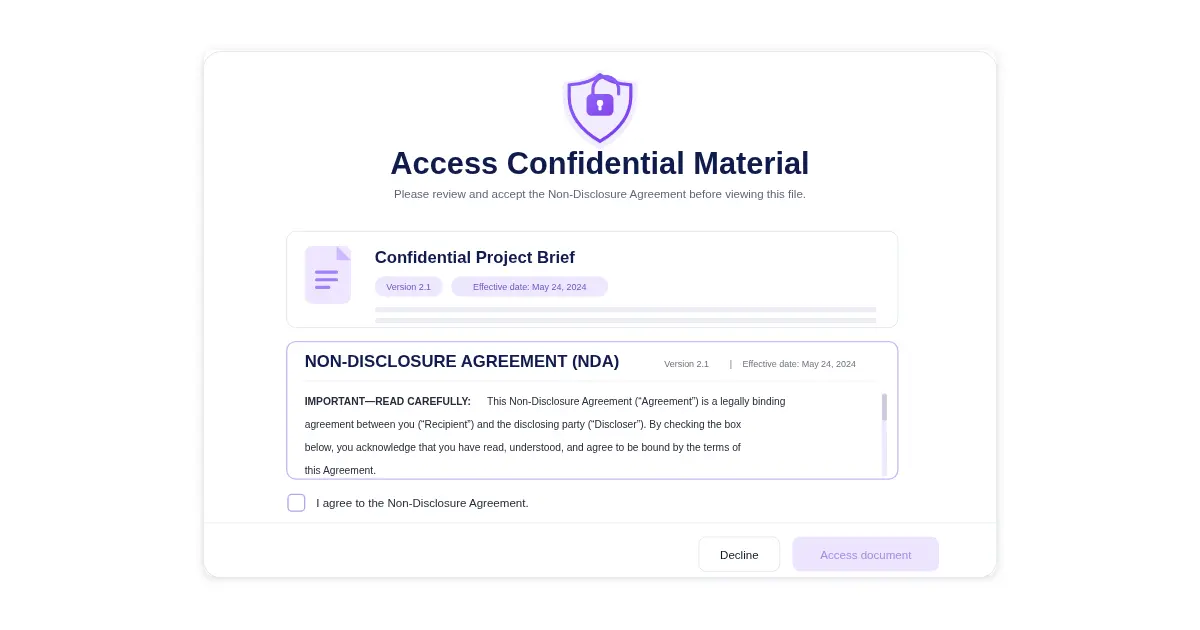
- Acceptance language - The action that constitutes acceptance must refer to the NDA directly. "I agree to the Non-Disclosure Agreement" is stronger than "Continue" or "Submit," because it ties the user's action to the confidentiality obligation rather than to the broader flow.
- Availability of the terms - The full NDA must be visible or accessible at the point of acceptance, through embedded text, a modal, or a clearly labeled link. The recipient should not have to leave the flow to know what they are accepting.
- The acceptance record - The business must be able to produce a record showing who accepted, which version of the NDA, when, and which access event the acceptance was tied to. NDA disputes turn on exactly these facts.
Where Clickwrap NDAs Are Typically Used
Clickwrap NDAs are most useful in workflows where confidentiality is tied to controlled access. The business is not negotiating a relationship; it is gating information behind a confidentiality obligation that needs to be accepted before disclosure happens.
The same pattern repeats across a handful of common scenarios, mirroring the broader set of clickwrap agreement examples used wherever standardized terms gate access:
- Trust centers and security documentation - Gating access to SOC 2 reports, penetration test summaries, and other audit materials shared with prospects and customers. The NDA typically limits use of the documents to internal evaluation and prohibits redistribution, with acceptance recorded per document and per version so the same prospect re-accepts when a new report is published.
- Due diligence and data rooms - Binding advisors, analysts, and deal team members who need to view materials inside a data room, often as a layer underneath a principal-to-principal signed NDA between the parties to the transaction. The clickwrap operates as a personal confidentiality obligation on each individual viewer, with logs that capture per-document acceptance and access events for downstream audit.
- Investor and pitch material access - Gating pitch decks, financial models, and fundraising materials shared with potential investors through document-sharing platforms, where the disclosing party wants confidentiality without slowing down the conversation. NDAs at this stage typically cover the existence of the conversation in addition to the documents themselves, and acceptance is tied to the access link rather than to a separately emailed agreement.
- Beta programs and early access - Tying participants to confidentiality before they receive access to unreleased builds, roadmaps, or feedback channels. The NDA usually pairs nondisclosure with feedback-ownership and embargo clauses, and re-acceptance is triggered when a new release tier opens or the program scope materially changes.
- Vendor and partner portals - Gating partner enablement hubs, reseller resource libraries, and vendor onboarding portals that contain confidential commercial information such as pricing tiers or technical integrations. The NDA is usually keyed to the partner's organization, and the individual user's acceptance carries an explicit warranty of authority to bind the partner entity.
The common thread across these workflows is the same: the disclosure is standardized, the recipient is not expected to negotiate the NDA, and the business needs to prove confidentiality was accepted before access was granted. Where those conditions hold, clickwrap NDAs typically fit the workflow better than a traditional signing process.
Clickwrap NDA vs Signed NDA
A clickwrap NDA and a signed NDA are not different because one creates confidentiality obligations and the other does not. Both bind a recipient to nondisclosure duties. The difference is the kind of proof each format is designed to create.
A signed NDA creates proof through formal execution. The legal record is centered on the executed document: the final text, the signer, the signature process, and any countersignature or negotiation history.
A clickwrap NDA creates proof through the acceptance event. The legal record is centered on the access flow: the NDA presented, the action used to accept it, the version accepted, the identity tied to the action, and the confidential material unlocked after acceptance.
That difference changes when each format is appropriate. A signed NDA is stronger when the question is, "Did the right person sign the right negotiated agreement?" A clickwrap NDA is stronger when the question is, "Did this recipient accept the standard NDA before receiving access?"
| Clickwrap NDA | Signed NDA | |
|---|---|---|
| Term negotiability | Non-negotiable; presented as-is | Negotiable; typically redlined before execution |
| Acceptance method | Affirmative click tied to a presented agreement | Handwritten or electronic signature on an executed document |
| Evidentiary focus | The acceptance event, the version presented, and the access it unlocked | The executed document, its final text, and signatory history |
| Authority to bind an entity | Inferred from the user account; an explicit authority warranty is recommended | Confirmed at signing through signatory designation and counterparty review |
| Time to disclosure | Immediate upon acceptance | Delayed by drafting, signing, and countersignature cycles |
| Scalability | High; the same flow serves any number of recipients | Low; each agreement is executed individually |
| Mutual obligations | Possible but unusual; bilateral confidentiality typically warrants negotiation | Standard where both parties exchange confidential information |
| Signature assurance (eIDAS / ESIGN) | Simple electronic signature | Advanced or qualified electronic signature, or handwritten |
| Typical use cases | Trust centers, data rooms, beta programs, partner portals | M&A, fundraising, strategic partnerships, IP disclosures |
The choice between the two is rarely about which format is more "legal." Both are. It is about which mechanism produces the right kind of proof for the situation. Where confidentiality is tied to controlled access at scale, clickwrap fits better. Where the NDA is part of a negotiated relationship or a transaction with higher legal stakes, a signed NDA fits better.
How to Use a Clickwrap NDA Correctly
A clickwrap NDA is only as reliable as the flow built around it. The legal conditions define what the agreement needs to look like; the implementation determines whether a specific acceptance can be reconstructed and relied on later.
- Placement in the user flow - The NDA should sit directly in front of the access point, with no path around it. If the same materials can be reached through another route without acceptance, the gate stops working.
- Interface design - The acceptance control should be an unchecked element the recipient must affirmatively interact with. Pre-checked boxes weaken the assent argument. The full NDA text should be visible or accessible through a clearly labeled link next to the acceptance control, with the same clarity on mobile as on desktop.
- What to capture in the record - The record should preserve enough to reconstruct the acceptance event: timestamp, user or account identifier, NDA version, and the specific access event tied to the acceptance. IP address and the action taken add further evidentiary weight.
- Version management - Each acceptance should be tied to the specific version of the NDA that was in effect at the time. Prior versions should be preserved, not overwritten, so the business can later retrieve the exact text the recipient saw.
- Re-acceptance for material changes - When the NDA is updated in a way that meaningfully changes the obligations, prior acceptance does not extend to the new terms. Users accessing protected information after the update should be presented with the new version and asked to accept it before proceeding.
Conclusion
Clickwrap NDAs are useful when standard confidentiality terms need to be accepted before access, without the friction of a traditional signing process. They work best for repeatable digital workflows where the recipient is not expected to negotiate the agreement.
Their strength depends on clear notice, affirmative acceptance, and a record connecting the recipient to the NDA version accepted before disclosure. Signed NDAs are still better for negotiated, high-value, or relationship-specific arrangements, but clickwrap NDAs can be a faster and more scalable option when confidentiality is tied to controlled online access. In practice, most teams adopt clickwrap software rather than building the consent UI, recordkeeping, and version-management infrastructure from scratch.