
When onboarding drags, the instinct is to look at the sales team. Hire another rep, tighten the pipeline, shorten the demo. For TelQ, the slow part was quieter. It was the contract. Every new client meant a round of legal negotiation before anyone could start paying.
This is the story of how TelQ took its own client onboarding from roughly 90 days to 16. The agreement step ClickTerm governs fell from 22 days to about 2, and end to end the path from registration to first payment dropped about 82 percent.
Why TelQ? Because ClickTerm started there, as an in-house answer to standard agreements that were slowing down onboarding, before becoming a product for businesses with the same problem.
Where TelQ's Onboarding Time Was Going
TelQ is an SMS testing and verification platform used by telecom businesses, gateway suppliers, bulk providers, routing companies, and operators, to measure real delivery quality across routes and suppliers.
Its clients are sophisticated buyers with their own legal teams. Onboarding each one meant getting three agreements accepted before the relationship could start:
- A privacy policy, accepted at website registration.
- Terms & conditions, accepted inside the application.
- A data processing agreement (DPA), accepted by the main account holder.
All three ran through DocuSign. Each agreement was sound and enforceable, but the signing format turned routine deals into drawn-out reviews.
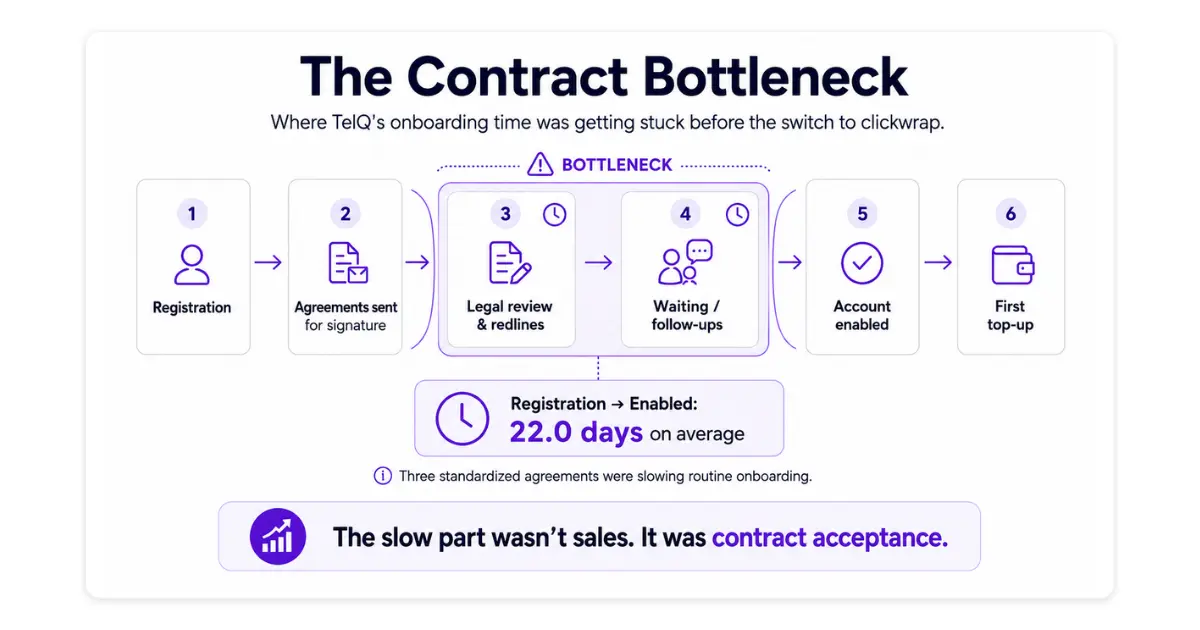
The numbers show it. Across 2025, the average time from registration to a paying customer was 90.6 days. The step where the agreements lived, registration to an enabled account, averaged 22 days on its own, and several monthly cohorts took between 130 and 190 days to convert end to end.
For a standardized product sold on standardized terms, that is a long time to spend not getting paid.
Why Signing Standardized Terms Creates Delay
The reason was not the tool used. The slow part was the format of assent. A document sent for signature arrives in an inbox with room for comments and a signature block at the end. That presentation says the terms are a draft and the next move is review, so legal teams reviewed and marked them up, even though the terms TelQ was prepared to offer never changed.
The negotiability was an illusion created by the format. The contract was standard, but it did not look standard, so it got treated like a starting position.
A signature flow is also asynchronous, which is where minutes turned to weeks. Send the contract, wait, explain that the terms are fixed, resend, sign... Each handoff adds a queue, and none of those queues are about real disagreement on the substance.
Clickwrap agreements close that gap. The terms are presented at the moment access depends on them, with no signature block to mark up and no invitation to counter.
For standardized terms accepted as-is, a properly recorded clickwrap is a simple electronic signature that creates a clear, enforceable assent record. What it removes is the implied invitation to negotiate terms that were never meant to be negotiated.
Moving the Agreements to Clickwrap
In November 2025, TelQ moved all three agreements into ClickTerm as clickwrap, each placed where it applies. The privacy policy is accepted at registration on the website. The terms and conditions are accepted inside the application. The DPA is accepted by the main account holder, the person with authority to bind the organization.
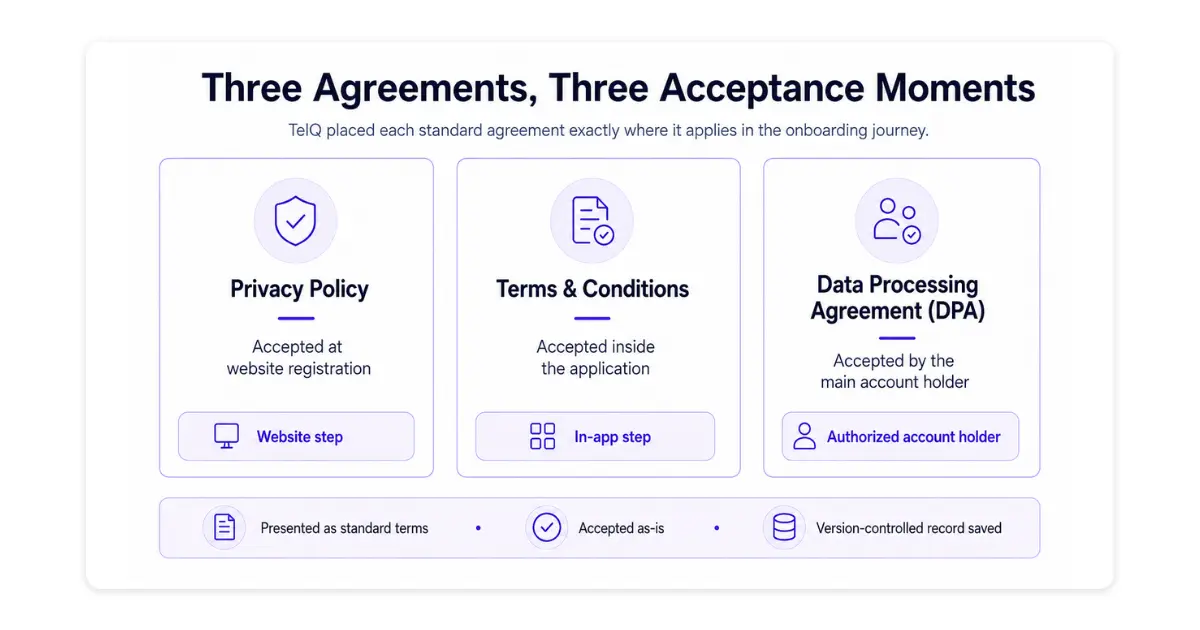
Each is presented as TelQ's most favorable standard contract, offered as-is, so there is nothing to redline. ClickTerm captures every acceptance as a version-controlled record of which terms each client accepted and when, tied to the account and the exact version shown. That is easier to reconstruct than a folder of separately signed PDFs.
The Results
The comparison below uses TelQ's 2025 onboarding cohorts, before ClickTerm, against the cohorts registered after the November 2025 switch, measured from registration to account enablement and from registration to first top-up (paying customer).
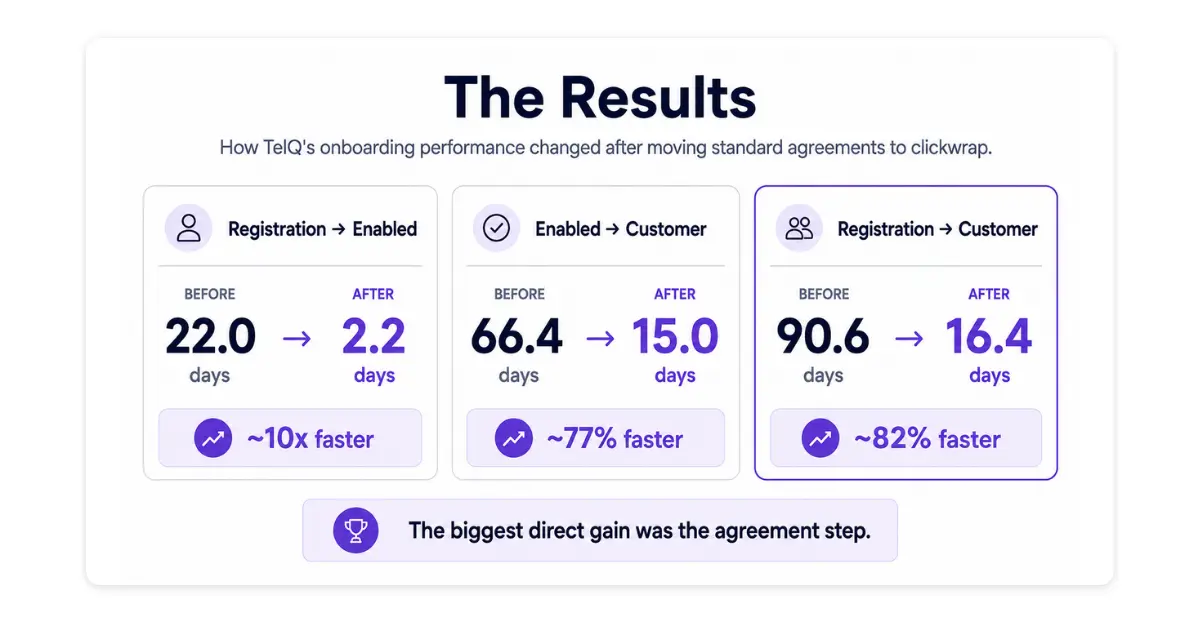
Start with the step ClickTerm directly governs. Registration to an enabled account, the stretch where the three agreements are accepted, fell from 22 days to roughly 2. That step depends primarily on how long the contract takes, which is why it moved the most.
End to end, the result holds across every post-switch cohort, not a single month, where early 2025 cohorts took 130 to 190 days to convert, the most recent 2026 cohorts are closing in 13 and 8 days on average.
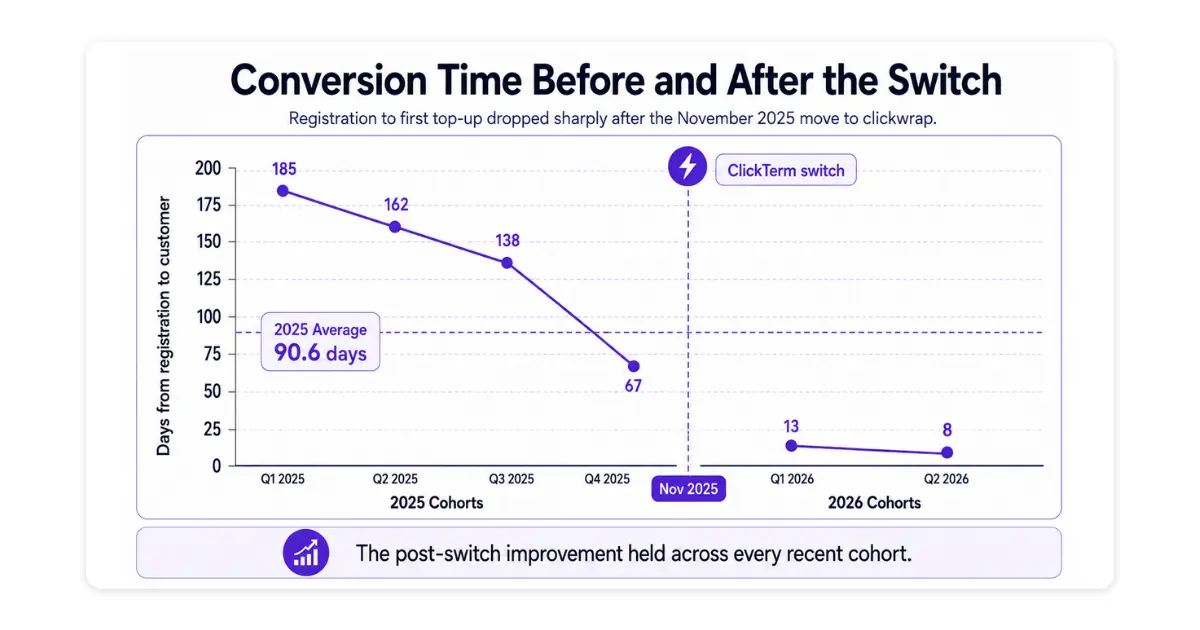
For TelQ, revenue arrives sooner, since a client counts as a customer at first top-up and cutting roughly 74 days off that path pulls cash forward on every client. Sales and legal capacity opens up, because legal is no longer pulled into routine deals and reps sell instead of chasing signatures. And every client lands on the same enforceable terms, rather than a hundred slightly different negotiated contracts that accumulate risk over time.
What ClickTerm Did, and What It Didn't
It would be easy to attribute everything to ClickTerm, but in the same period, TelQ added a salesperson and brought AI into parts of the onboarding flow. One of the sharpest single-month gains in the enablement step, from roughly 4 days to under 1, lined up with AI entering that part of the process.
However, by TelQ's own estimate, more than half of the total reduction is attributable to ClickTerm, the rest to the added capacity and automation.
What ClickTerm owns cleanly is the contract bottleneck. The registration-to-enabled step is where the tenfold improvement shows up most directly, and it is the part that did not depend on hiring or tooling elsewhere in the funnel. The other gains stack on top of that with sales representatives freeing up their time from back-and-forth contracting.
Before ClickTerm, our legal review process routinely delayed onboarding even when customers ultimately accepted the same terms. After moving to clickwrap, contract acceptance became one of the fastest parts of onboarding rather than one of the slowest.
— Oana Dukanac, CCO
When Clickwrap Fits, and When It Doesn't
The lesson is not to replace every signature with a click. Clickwrap fit TelQ's onboarding because the terms were standardized, offered as-is, and gated access to a defined product rather than recording a one-off negotiated deal.
The same is true of standard SaaS terms, privacy policies, routine DPAs, and take-it-or-leave-it commercial terms.
Where those conditions do not hold, a signed document still earns its place. A heavily negotiated enterprise agreement, a contract with bespoke terms, or a transaction the law reserves for higher-formality execution is not a candidate for clickwrap, and treating it as one trades a real negotiation for a weaker record. The skill is knowing which agreements are genuinely standard, and moving those out of the signature flow while leaving the rest where they belong.
For TelQ, three onboarding agreements were clearly standard. They had been treated as negotiable only out of habit, and that habit was costing the business about two and a half months per client.
Conclusion
The same bottleneck may already be sitting in your own onboarding. A standard agreement, sent for signature, holding up a customer who has already decided to buy. Not because the terms need negotiation, but because the process invites it.
Clickwrap removes that false pause. Customers accept the terms at the point of signup or access. Legal stops reviewing redlines on agreements that are not meant to change. Sales stops chasing signatures before revenue can start.
For agreements that should never have become legal projects, ClickTerm turns acceptance into part of onboarding. The terms stay controlled. The record stays clear. The customer keeps moving.