
You added an "I agree" button, linked your terms, and moved on. Most of the time that is enough: clickwrap agreements are enforceable across virtually every major legal system, and the rule is so well established it is usually treated as the end of the discussion rather than the beginning.
In practice, though, enforceability is only ever tested when an agreement is challenged, and at that point the general rule counts for little. A clickwrap acceptance is a simple electronic signature, valid but low-assurance, so what decides the case is the particulars around it: how the flow presented its terms, how assent was captured, what record survives, and whether the terms can lawfully bind the person who accepted them. Those details, not the format itself, are where otherwise routine clickwrap agreements hold up or fall apart.
What Clickwrap Enforceability Means
Clickwrap enforceability is the degree to which a court will treat a clicked agreement as a binding contract and give effect to its terms. It depends on how your particular flow is built and what its terms say. Two businesses can both rely on clickwrap and reach opposite outcomes in litigation, depending on how the flow presented its terms, how assent was captured, and what the terms themselves provided.
A clickwrap is an ordinary contract, formed through an offer in the terms presented, acceptance in the user's affirmative action, and consideration in the exchange of value. The click itself functions as a simple electronic signature, legally sufficient to form a binding contract but the lowest-assurance tier in systems that grade signatures, below the advanced and qualified signatures that carry stronger built-in proof. Functional-equivalence laws such as ESIGN and UETA, eIDAS, and their counterparts worldwide confirm a contract cannot be denied validity merely because it was concluded with a click.
That low assurance is why a clickwrap dispute is rarely about whether a click can form a contract. The surrounding record has to supply the assurance the signature itself lacks, which narrows the contested questions to two. Was this particular user bound, and can the terms they accepted be enforced against them?
Requirement 1: Make Notice and Assent Unmistakable
Across jurisdictions, courts assess online contract formation against the same two elements. The user must have had reasonable notice of the terms, and must have taken an action that unambiguously communicated acceptance.
The terminology varies. United States courts ask whether notice was reasonably conspicuous, English law whether terms were brought to the user's attention before contracting, EU consumer law whether they were transparent and accessible. The underlying question is identical, namely what combination of on-screen presentation and user action is enough to bind a party who has, in all likelihood, not read the terms.
Notice of the Terms
There is no bright-line rule for what makes notice conspicuous. Courts assess the screen as a whole, and in some cases the circumstances of acceptance as well. Flows have failed both because the notice text was visually indistinct from the surrounding page and because the user was being hurried through the acceptance step in a way that undermined any meaningful opportunity to review the terms.
In practice, the recurring points of examination are:
- Whether the hyperlink to the terms is visually distinguishable from the surrounding text
- Whether the notice sits close to the acceptance control rather than elsewhere on the page
- Whether the screen is cluttered with competing elements that draw attention away from the notice
- Whether the mobile layout preserves these qualities, since designs that work on desktop frequently separate the notice from the button on smaller screens
A further pattern holds consistently across jurisdictions. Terms that waive significant rights attract heightened notice scrutiny. Arbitration clauses, class-action waivers, jury-trial waivers, and liability exclusions are often the provisions a business most needs to enforce, and they are precisely the provisions courts examine most closely.
In Chilutti v. Uber, a Pennsylvania appellate court declined to enforce Uber's arbitration clause on the basis that users had not been clearly informed they were waiving their right to a jury trial. The broader principle is that the more consequential a clause, the less a business can rely on the user discovering it within a linked document.
The Act of Acceptance
The second element is independent of the first, and a flow can satisfy the notice requirement yet fail on assent. The baseline is an affirmative act, clicking a clearly labeled button or checking a box that begins unchecked. A pre-checked box does not qualify, under both ordinary contract analysis and EU consent rules, because a default state is not a decision.
The requirement behind most recent failures is subtler. Your user has to understand what the action signifies. A button labeled "Continue" or "Sign up" reads as navigation, not acceptance.
In Chabolla v. ClassPass (2025), the Ninth Circuit declined to enforce an arbitration clause because the interface never conveyed that clicking "Continue" meant agreeing to anything. Absent language tying the action to the terms, such as "By clicking Continue, you agree to the Terms of Service," the click cannot communicate agreement. The same court added that notice and acceptance must appear together on one screen, since several inadequate notices do not combine into one adequate one.
This is also where a business's own label carries no weight. A court classifies a flow by its mechanics. An action directed at the terms is clickwrap and is routinely enforced, while a flow that merely tells users some other action implies agreement is the weaker sign-in wrap.
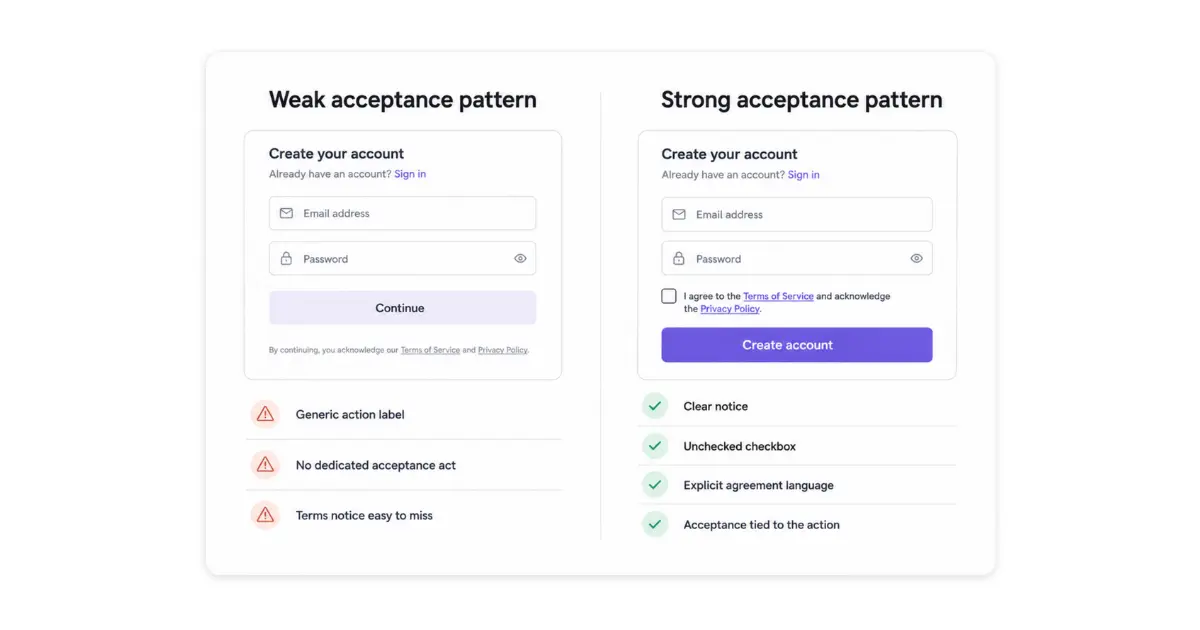
Many recent losses were flows their operators assumed were adequate clickwrap but which, lacking a dedicated acceptance act, were judged as sign-in wrap and failed. The safeguard is to build the clickwrap around a dedicated, unavoidable acceptance act tied by explicit language to the terms, the feature that separates a true clickwrap from browsewrap, whose enforceability depends on the facts.
Requirement 2: Be Able to Prove the Acceptance
Doctrine decides what you have to establish. The evidence decides whether you can. This is the stage at which even well-designed flows fail, often years after the design choices were made.
Reconstructing the Acceptance Event
When a user swears, under oath, that they never accepted your terms, the burden falls on you to show that they did. Assertion will not do it, and neither will a record that only confirms a click happened. What persuades a court is evidence detailed enough to answer four questions about the acceptance in dispute.
- What did the user see? A screenshot of the current website establishes little about what a user encountered months or years earlier, because interfaces change. What is needed is a record of the screen as it was presented at the time of acceptance.
- What did the user agree to? The full text of the specific version of the terms in effect at that moment, rather than a link to a URL whose contents have since changed.
- What action was taken, and when? The acceptance itself, recorded on the backend with a timestamp, rather than inferred from front-end state.
- Who took it? The acceptance must be attributable to an identifiable user, account, or transaction. A log entry showing that some acceptance occurred does not establish that this user accepted these terms.
Integrity matters because a record the business could have altered after the fact invites the very argument it is meant to foreclose, which is why audit trails and tamper-evidence count as much as the data itself. Retention matters because records should survive as long as claims under the agreement may arise, often six years or more, while GDPR data-minimization rules require a documented basis for keeping records that contain personal data. Capturing all four answers for every acceptance, in a form that cannot be altered afterward, is what dedicated clickwrap software is built to do.
Version Control and Changing Your Terms
Terms are revised over time, and each revision creates a new evidentiary problem. Courts have declined to enforce agreements where a business could show the user accepted some version of its terms but not which one, since the clause being relied upon may not have appeared in the version the user actually saw.
Two rules make this stricter than it looks. Users have no duty to monitor a business's terms for changes, and in Douglas v. Talk America (2007), the court held that a customer cannot be bound by revised terms merely because they were posted to a website.
A right to change terms can also be drafted too broadly. US courts have treated a clause permitting unilateral modification at the company's sole discretion as rendering the contract illusory, while the EU and UK treat one-sided variation clauses as presumptively unfair.
So treat any material change as a new acceptance event. For revisions that touch dispute resolution, pricing, or liability, capture fresh recorded acceptance of the new version and keep the prior version with its records. Notice plus continued use may be enough for minor changes in some places. But it trades a record you can prove for one you will have to argue.
Requirement 3: Keep Your Terms Fair Enough to Survive
Much clickwrap commentary stops at formation, but a validly accepted agreement can still fail on the substance of its terms. Because clickwrap is the paradigm of a take-it-or-leave-it contract, the terms it captures are exactly the kind that every major legal system reviews for fairness, whether through the US doctrine of unconscionability, the EU and UK rules that make unfair consumer terms non-binding regardless of acceptance, or Australia's civil penalties for unfair standard-form terms.
The practical lesson is that one-sided terms are a liability even when the click is flawless, and courts will not always salvage them. In Rios v. HRB Digital (N.D. Cal. 2025), a court found an arbitration clause so structurally unfair that it refused to sever the offending provisions and voided the entire agreement. Canada's Supreme Court did much the same in Uber v. Heller (2020), striking a clause that forced a Toronto driver to arbitrate in the Netherlands at a cost near his annual income.
Two related limits round this out. Mandatory protections can override an accepted clause entirely, which is why consumers often cannot be held to forum-selection or choice-of-law terms they genuinely clicked. And contractual assent is not the same as privacy consent. Under the GDPR, consent to data processing must be freely given, specific, and as easy to withdraw as to give, so a single "I agree" cannot validly cover both the contract and the data processing, and the two are best captured separately.
How the Standards Evolved
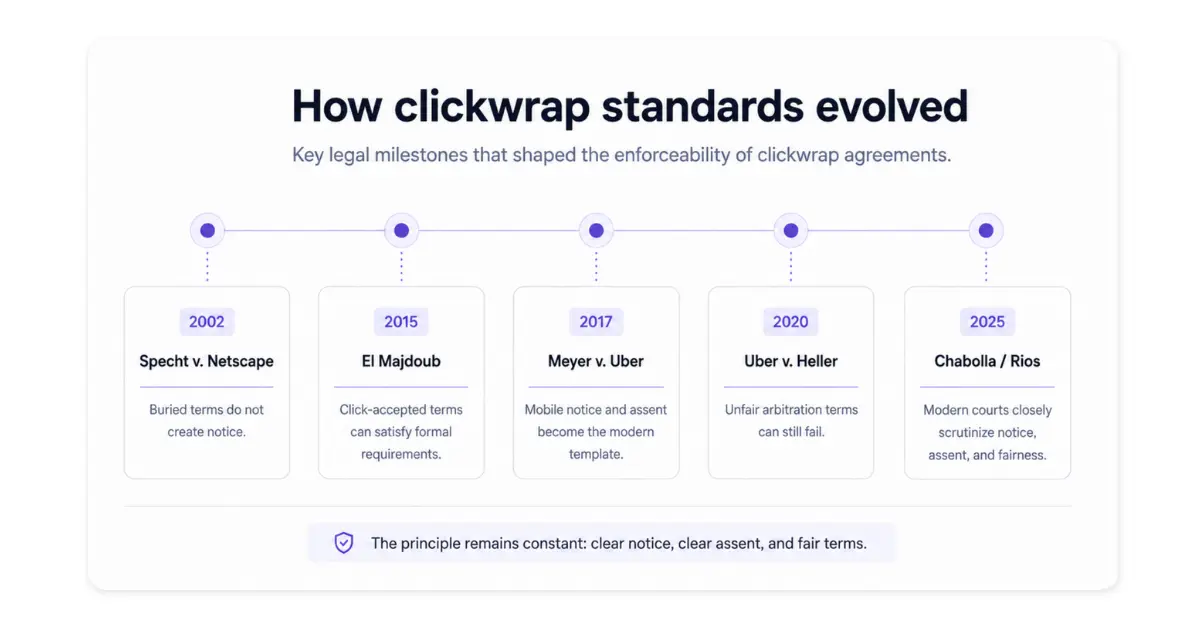
The foundations (2002 to 2007). The starting point is Specht v. Netscape (2002), which established the notice principle, that users cannot be bound by terms they had no reason to know existed. The early cases set the basic bargain, that a clear act of acceptance is enforced and a buried link is not.
The principle settles and spreads (2015 to 2017). Meyer v. Uber (2017) translated the test to mobile interfaces and became the template most courts now apply, enforcing a sign-up flow precisely because the screen made the terms conspicuous and tied the user's action to them. The EU reasons the same way. In El Majdoub (2015), the Court of Justice held that click-accepted terms can satisfy the formal requirements for jurisdiction clauses, turning on the same clear, deliberate act of acceptance.
The modern period (2022 onward). What has changed recently is intensity, not principle. Courts now scrutinize acceptance screens closely enough that closely comparable flows can yield opposite results, and transactional context has entered the analysis, so a user deliberately registering for a paid subscription may be expected to anticipate contractual terms more readily than a casual visitor. The constant across every era and jurisdiction stays the same. A dedicated, clearly labeled acceptance act is enforced almost everywhere, while weaker formats remain contingent on the facts.
When Clickwrap Is Not Enough
The analysis to this point assumes that clickwrap was an appropriate method for the transaction in the first place. Several boundaries are worth noting.
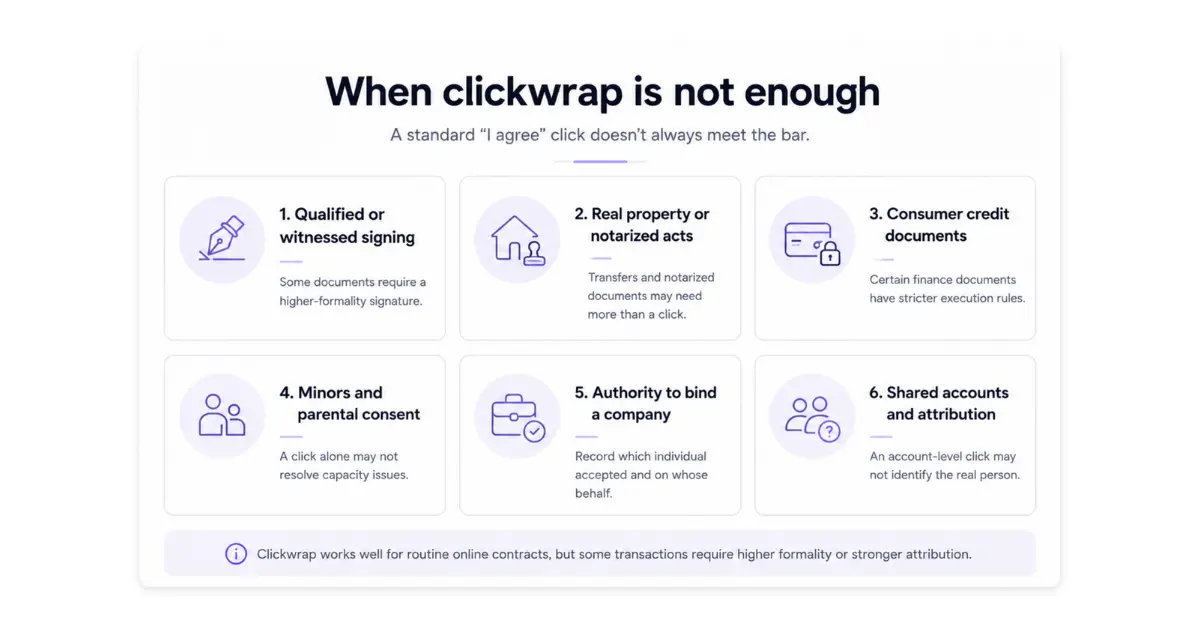
Formality requirements reserve certain documents for higher-formality execution, including agreements requiring notarization or witnessing, certain guarantees, transfers of real property, and various consumer-credit documents. In tiered systems such as eIDAS, some of these require a qualified electronic signature, which a clickwrap acceptance cannot satisfy regardless of how well it is recorded.
Capacity is a separate limit. Contracts accepted by minors are voidable at the minor's option in most legal systems. Where a service is likely to be used by minors, no acceptance flow resolves this on its own; the realistic mitigations are age verification and, where appropriate, parental acceptance.
Agency and shared accounts raise questions of attribution. When an employee clicks "I agree" on behalf of an organization, the organization is generally bound provided the employee had actual or apparent authority, which is routine for everyday business tools but more contestable for significant commitments. Shared accounts present the converse difficulty, since an acceptance attributable to an account is not automatically attributable to the particular individual a business may later seek to bind.
Conclusion
Clickwrap enforceability turns on three things: how the agreement was accepted, whether that acceptance can be proven, and what the terms themselves provide. The acceptance moment should present notice, the terms, and an explicit act of agreement together; every acceptance should be backed by a record of the screen as shown, the version accepted, the timestamp, and the user; and the terms must stay within what fairness review will tolerate.
The agreements that fail in litigation are rarely those of businesses without terms. They are the agreements of businesses that could not show what the user saw, could not establish which version was accepted, or sought to enforce a clause the law was never going to permit.