
Electronic signatures are treated as the default way to make an agreement binding online. Prepare the document, route it to each party, collect the signature, store the executed copy. For a negotiated contract, that is the right process. For the far larger volume of standardized agreements a business forms every day, it adds friction without adding much proof.
A clickwrap acceptance is itself an electronic signature. It binds under the same laws as a signed document. What changes between the two is the kind of agreement each is built for and the kind of proof each leaves behind.
What Is an Electronic Signature?
An electronic signature is a digital method of showing consent, agreement, or approval on a record. It stands in for a handwritten signature and can take the form of a typed name, a signature drawn with a mouse or touchscreen, or a click on an "I agree" button.
The law defines it the same broad way. Under the U.S. ESIGN Act and UETA, an electronic signature is "an electronic sound, symbol, or process attached to or logically associated with a record and executed or adopted by a person with the intent to sign the record." That breadth is deliberate, and it is why a clear click to accept presented terms qualifies.
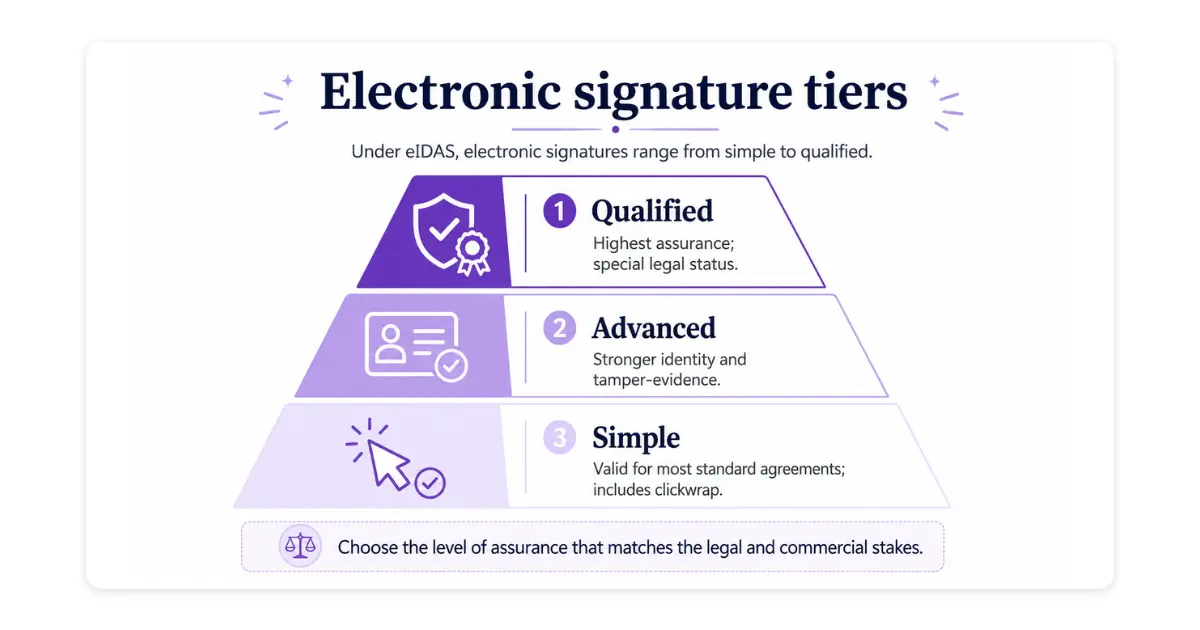
The EU's eIDAS framework sorts electronic signatures into three tiers: simple, advanced, and qualified. A simple electronic signature is the base level and is valid for most agreements. Advanced and qualified signatures add verified identity and tamper-evidence, and are reserved for documents where the stakes justify the extra assurance.
Is Clickwrap an Electronic Signature?
A clickwrap acceptance is a simple electronic signature. When a user is shown terms and clicks a clearly labeled control to accept them, that click is a process adopted with intent to sign, which is exactly what ESIGN and UETA describe.
Courts have treated it that way for years. In Meyer v. Uber, the Second Circuit enforced an online acceptance flow because the user had reasonable notice of the terms and took a clear action to accept them. That is the same standard any electronic signature has to meet.
The flip side is that a click only binds when the flow is built for it. Notice has to be clear and the acceptance act unavoidable. What carries a clickwrap in a dispute is the record around the click: who accepted, which version of the terms they saw, when, and the acceptance act tied to it. Get those right and the click holds. Leave them thin and it drifts toward the same weakness as browsewrap, which is where clickwrap enforceability is won or lost.
The word "simple" matters, too. Under eIDAS, clickwrap sits at the base tier. It is fully valid for standard agreements, and it does not carry the heightened identity assurance of an advanced or qualified signature.
How E-Signatures and Clickwrap Differ
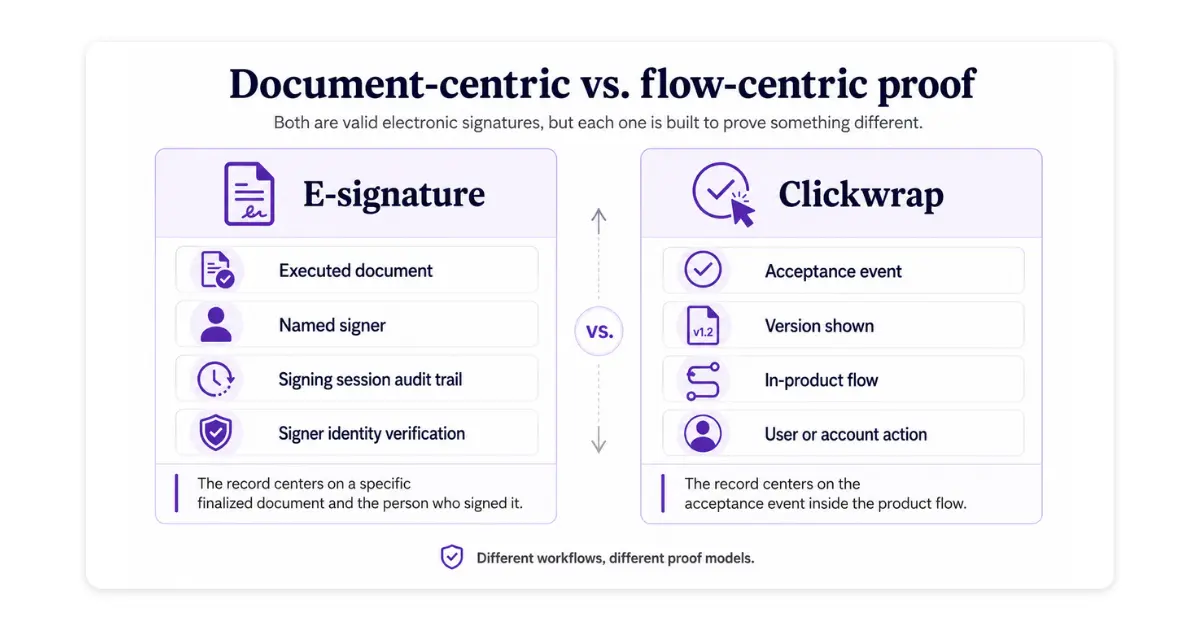
Both are valid electronic signatures. They differ in what each one is built to capture. Throughout this comparison, "e-signature" refers to a dedicated document-signing workflow, even though clickwrap is legally an electronic signature too.
A dedicated e-signature is document-centric. The unit of the agreement is a specific document, often negotiated, signed by named parties. The record is built around that file: the final text, who signed, when, and the audit trail of the signing session. Its job is to prove that a specific, named person signed a specific document.
A clickwrap is flow-centric. The unit is the acceptance event inside a product. The record is built around the flow: the terms as they were presented, the version shown, the action the user took, the timestamp, and the account tied to it. Its job is to prove that a given user accepted a given version of the terms before proceeding.
| Clickwrap | E-Signature | |
|---|---|---|
| The agreement | Standardized terms, presented as-is | Often negotiated or individualized |
| How it's accepted | An affirmative click on a presented agreement | A signature applied to a document |
| Who accepts | Any user, often a consumer | A named, identified signatory |
| Identity assurance | Tied to an account or session | Verified per signer via email, SMS, or ID |
| Signature tier (ESIGN / eIDAS) | Simple electronic signature | Simple to qualified, depending on method |
| What the proof centers on | The acceptance event and the version shown | The executed document and signer identity |
| Speed to agreement | Instant, inside the product flow | Delayed by sending, signing, and returning |
| Cost at scale | Flat, one flow serves everyone | Per-signature or per-envelope |
| Best fit | Signup, checkout, API terms, policy updates | Contracts, employment, property, financing |
Where Clickwrap Is the Better Choice
For agreements that are standardized and formed at volume, clickwrap is usually the better mechanism. Forcing a document-signing workflow into these situations adds friction the agreement never needed.
- Self-serve signup and terms of service - Registration is where most users first accept a company's terms of service and privacy policy. Routing a document for signature here would break the flow for no gain. A clickwrap ties acceptance to the account being created and records it without interrupting the flow.
- Checkout and subscription terms - Purchase and renewal terms need to be accepted at the moment of the transaction, across every customer, with no delay. Clickwrap binds the buyer in the same click that completes the order.
- API and self-serve SaaS terms - Developer and product terms are accepted by thousands of users who will never negotiate them. A per-envelope signing process does not scale to that shape. A single presented agreement does.
- In-product policy updates and re-acceptance - When terms change materially, affected users must accept the new version. Clickwrap can present the updated version and record fresh acceptance at scale, tied to the exact text each user saw. Re-sending a document to an entire user base for signature is not realistic.
- Marketplace and platform onboarding - Two-sided platforms onboard many participants under the same standardized terms. Clickwrap gates access to each side consistently, without a manual signing step per participant.
Where the terms are fixed, the counterparties are many, and the agreement has to form in the flow rather than in an inbox, clickwrap delivers speed, scale, and a record tied to the version each user actually saw.
Where an Electronic Signature Is Still the Right Tool
Clickwrap does not replace document signing everywhere, and using it for the wrong agreement is its own mistake. A dedicated e-signature is the better choice when the agreement carries individual weight rather than volume.
- Negotiated contracts - Master service agreements, partnership deals, and other documents that are redlined before execution need a format built around the final negotiated text, not fixed take-it-or-leave-it terms.
- A named signatory with confirmed authority - Where it matters that a specific person with authority to bind an organization signed, a designated-signatory workflow establishes that far more directly than a click under an account.
- Higher assurance or statutory formality - Some agreements call for an advanced or qualified electronic signature, or for notarization or witnessing. A simple electronic signature cannot satisfy those requirements no matter how well the acceptance is recorded.
- High-value or high-stakes documents - Employment agreements, real property transfers, financing documents, and significant one-to-one NDAs justify the added friction of a formal signing process for the stronger evidentiary record it produces.
Conclusion
Clickwrap is a real electronic signature, and for the agreements most businesses handle at volume it is the better one. The terms are standard, the acceptance happens inside the product, and the proof is tied to the exact version each user saw.
Dedicated e-signatures still matter where agreements are negotiated, individual, or consequential on their own. The trade-off comes down to what each format is built to prove. For the flows that run a product day to day, most teams reach for clickwrap software rather than build the consent UI and recordkeeping themselves, and for those agreements that is usually the right call.